A Decade in an Eternal War


1511568_2898371389516_1225581515123098555_o-7362680

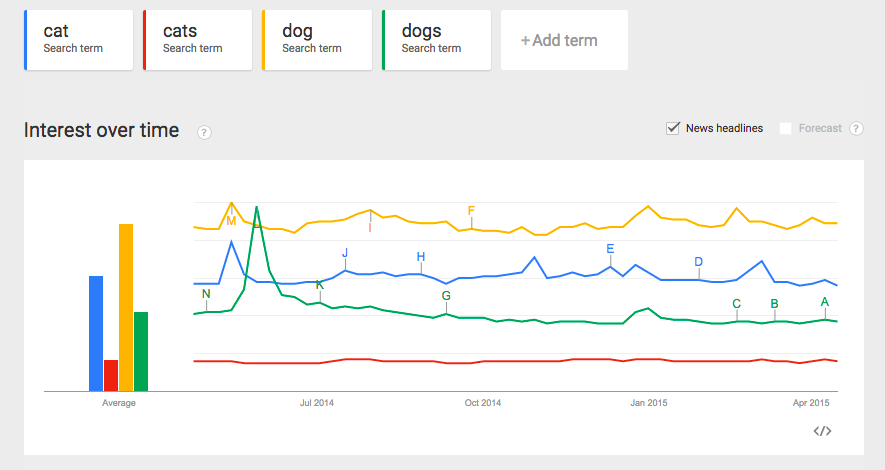
10 years of cat v dog & cats v dogs.

A view of a decade of battles between 2010 to 2014 in the eternal war for human affection.

Fluffy Spike


image-asset-6459142

Year over year view of interest in our furry friends. Popularity spikes in late spring with
“dog”, and then “cat” leading the way only to have “dogs” sprint up a month later.

As someone who loves dogs, the data is pleasantly surprising.

I expected the popularity of cats to be higher.


grumpy_cats-2662919

Evolution of an Interface

To see how Google evolved their Trends interface scroll the gallery below.

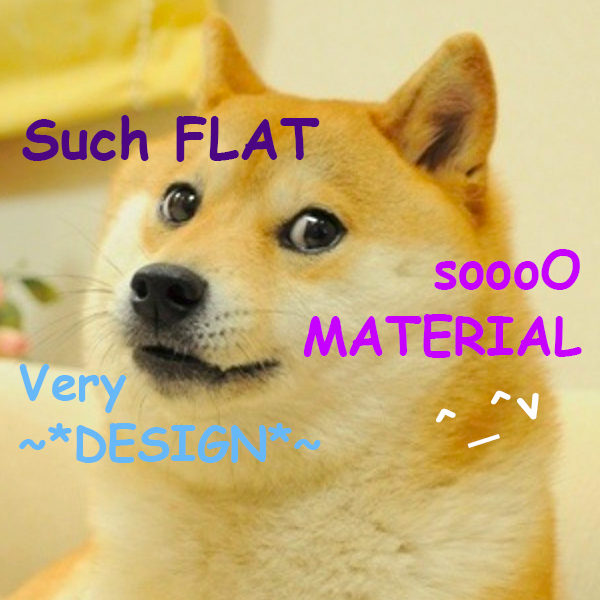
Sources: Google Trends, Grumpy cat, Doge.

Post from 2011

“A Design and Innovation Company””We exist to design beautiful experiences.”

Featured Speaker

“Presenting the Sunshine Generation: China’s answer to Gen-Y Jeremy Kaye, Creative Director, Ziba Design Karen Reuther, Director of Consumer Insights and Trends, ZIBA Design

Jeremy and Elizabeth will relate some surprising insights about young Chinese consumers gleaned over 350 person-days of in-country research: Their unique attributes and their expectations for design and consumer experience. Broader implications are also presented for effectively serving this diverse and nuanced market.

Jeremy Kaye

Jeremy’s deep knowledge of business and design enables him to identify how design can solve complex business problems for organizations and industries on the brink of change. His clients at Ziba have spanned numerous industries, including health insurance, retail, finance, and hospitality.

Prior to Ziba, Jeremy worked with consumer-experience driven brands—J.Crew, Patagonia, and Nike—to lead brand, design, and marketing efforts in support of new business opportunities. Jeremy has a Bachelor of Science in Clinical Psychology from University of the Witwatersrand in South Africa, and a Bachelor of Science in Product Development and Marketing from the Fashion Institute of Technology in New York City. He has lectured at Parsons the New School for Design, and contributed to BusinessWeek.

Karen Reuther

At Ziba, Karen leads our team tasked with surfacing innovative, relevant and compelling insights that define and deliver consumer experience innovations. Karen is a master connector—ensuring that insights translate to real design solutions. Prior to Ziba, she worked at Nike as Global Creative Director – Color, Graphics and Materials. There she led the creative vision and implementation of design strategies from product creation to merchandising across footwear, apparel and equipment. Karen has a Bachelor of Arts in Industrial Design from Purdue University and a Master of Science in Business from Lesley University.

Ziba

Ziba is a design and innovation consultancy based in Portland, Oregon. For more than 25 years, Ziba has provided companies large and small with award-winning design and innovation solutions.”

via http://www.dmi.org/dmi/html/conference/annual10/sp_ziba.htm
 

Modern Manufacture and Design
“And you must remember always that your business, as manufacturers, is to form the market, as much as to supply it. If, in short-sighted and reckless eagerness for wealth, you catch at every humor of the opulence as it shapes itself into momentary demand – if, in jealous rivalry with neighboring States, or with other producers, you try to attract attention by singularities, novelties, and gaudiness – to make every design an advertisement, and pilfer every idea of a successful neighbor’s, that you may insidiously imitate it, or pompously eclipse – no good design will ever be possible to you or perceived by you. you may, by accident, snatch the market; or, by energy, command it; you may obtain the confidence of the public, and cause the ruin of opponent houses; or you may, with equal justice of fortune, be ruined by them. But whatever happens to you, this, at least, is certain, that the whole of your life will have been spent in corrupting public taste and encouraging public extravagance. Every preference you have won by gaudiness must have been based on the purchaser’s vanity; every demand you have created by novelty has fostered in the consumer a habit of discontent; and when you retire into inactive life; you may, as a subject of consolation for your declining years, reflect that precisely according to the extent of your past operations, your life has been successful in retarding the arts, tarnishing the virtues, and confusing the manners of your country.”

pg 288 The Genius of John Ruskin.

The 1st annual Contact Summit is a working festival of innovation where the net’s leading mindsand entrepreneurs can connect with the people who are building the social technologies of tomorrow.
The net of the future will not be fueled by ads, but by people solving real problems through distributed,
peer-to-peer solutions. This is the dormant promise of the Internet, finally coming to fruition.

Contact brings together recognized social technology companies like Foursquare, Meetup.com,
Kickstarter, and Etsy, together with technologists, academics, artists, students and entrepreneurs.
Participants include Dennis Crowley, Douglas Rushkoff, Al Orensanz, Steven Johnson, Clay Shirky,
Dave Winer, Daniella Jaeger, Joanne McNeil, Venessa Miemis, Richard Metzger, and many others.

The day consists of a morning of “provocations,” an afternoon of participant-led discussions,
and a 2 hour long Bazaar and exhibitor space. Budding entrepreneurs can pitch their ideas
and demo their projects with the chance of winning one of three $10K Innovation Awards to
support and accelerate their mission.

copy via

http://contactcon.com/
October 20, 2011. New York, NY

A lot of buzz about the Joby and Peter Stathis collaboration.It’s a strategic move for Joby to apply their technology, team and knowledge to a different type of product and target market.

[singlepic id=1059]
[singlepic id=1060]
They have received good reception online at blogs like Co.Design and there was a good reception at CITE showroom in SoHo.
[singlepic id=1071]
[singlepic id=1062]

[singlepic id=1058]
George from CITE with some Parsons students.

There was another reception for Stathis the next Monday at Phaidon.

[singlepic id=1063]
While the light given off isn’t harsh like most LEDs, other parts of the design could use some critiquing.
Many people thought the power button was a dial to tone up or tone down.
If they just had holes (no LEDs) in a circle and then one LED in the center of that circle, that would make more sense – as in the single button signifying “Press me.”
Versus the circle of buttons signifying “Touch or swipe us.”

CITE’s manager George with one of his creations
[singlepic id=1051]
[slideshow id=77 w=695 h=462]
See more of George’s work at le mouton noir and co.
Event info via Core77
Experience light and embrace movement as CITE presents the global launch of the JOBY | Peter Stathis Venture Collaboration. The California-infused lighting line invites you to delight your senses and engage with deceptively simple, surprising and futuristic approaches to the modern interior. Join us to celebrate this dynamic approach to entrepreneurialism and design while rediscovering your youthful sense of wonderment and play.

[nggallery id=78]

At ICFF even though there was carbon fiber and metals of different alloys, the two most impressive materials were the use of tin and the use of clay.
One Japanese company Koyo Ibushi uses clay that can be used for tiles, counter tops, pottery, or created into sculpture.
[singlepic id=990]
[singlepic id=991]

It’s a chic and dark aesthetic, like carbon fiber but changes with the presence of water. They bake the clay for four days to achieve that look.
[singlepic id=992]
I inquired about it’s durability and they said that if it wears away or chips, it still keeps that dark look because it’s not a finish, but more of a cure.

Nagae, also from Japan
[singlepic id=1000]

This is a case where the chef can use the tableware to inform how the food is created.
[singlepic id=998]
[singlepic id=999]
You only really need a small collection of this tableware and can have sets pre-adjusted to each course.
It’s not just modular (in that you could create custom cuts and combine them) but they are malleable.
Then I imagine all the restaurant patrons playing with the tableware.

[singlepic id=1020]
Art Center’s work was very skillfully designed and crafted to the point where it’s ready for the showroom. Upon asking an Art Center student if a collection of chairs was his piece he replied “Yes, it’s a school project.”

I like how these chairs are separate but allow you to interact with the person sitting next to you. Almost as social as a couch, but independent like a chair.
That’s something important to note. People adjust chairs when they sit down, one of the main reasons is for a feeling of independence. Few airports, parks or other public places take note of this.

Parson’s school project for Metropolitan’s booth uses yarn. To create the booth out of the shape and color of Metropolitan’s 30th anniversary logo.
[singlepic id=1026] I feel a heavier use of yarn in some spots could give the contour booth more of a presence so the viewer feels like they are looking at something not just between the space of the yarn. But, it’s still much better than one of the booths that felt like a prison. We walked in and didn’t know there was more than one exit.

Germany’s design booth was quite poorly put together. They showcased a bench that you could not yet sit on. It was a bench created for transportation hubs like airports and bus stations. As one research documentary phrased it, benches are best use to “accent architecture photographs.”

Weirdly enough, the catalog for the bench was sealed in an envelope. Not surprisingly, the catalog only featured four photos of people – the owners and probably the designers. Only one of the photos features people sitting in the benches.

Germany did show a myoelectrically controlled hand prosthesis, which intrigued me. But I don’t know why the part where the prosthesis joins the elbow is blue. It’s as if to say “this is where manufactured ends and skin begins,” as if we wouldn’t know that. Some hand prosthesis models are made of carbon fiber, black metal or red metal. I agree that having a fake skin tone is might not be the way to go, but why show where there is there difference instead of just showing what is?

Worst of all the hand was displayed on the wall being held up by a plastic cable. A sort of insensitive way represent something that is supposed to take place of what a human lost. There was light in terms of design for healthcare.
[singlepic id=1019]
[singlepic id=1018]

Futrus, the booth with what I find to be the most impressive offering doesn’t have a unique point featuring carbon fiber or laser cut patterns but just solid top. Well solid top and knocked-out corners. With a non-porous top they can create patient rooms that are resistant to virus, bacteria, mold, stains and scratches.
[singlepic id=1037]
There are more curves instead of corners as to not trap dirt. I asked about the seams on the handles and between panels, they said they seal the corners to also be anti-microbial.

Futrus said that there aren’t other companies offering this service. Some companies offer a bespoke sink or countertop, but not full rooms.

Since Futrus can panels with color or faux-wood finish.

Another reason they are impressive is because they explicitly target both the healthcare industry for institutional contracts as well as a retail distribution for their consumer line of furniture.

Molo environments are intriguing in that they can be packed flat and then expanded for create micro-environments. My friend said they were used in the 2008 Sichuan earthquake to create networked hospital rooms. I can envision Molo and Futrus working together. Molo exteriors with Futrus tabletops and equipment. Then burning the Molo tents afterwards to be super safe.
[singlepic id=1048]

Other cool things:
Human form – corrugated cardboard
[singlepic id=986]
Moleskine brand extensions –
[singlepic id=976]
Moleskine rep said the brand-name is of unspecified origin so it can be pronounced anyway.

Foldable chair-

[galleryview id=075]

[nggallery id=76]

[singlepic id=973]See notes in moleskine

Why did Jason Wing go back to China?
Well Xu Bing finds it to be a massive laboratory for testing.

http://video.ft.com/v/942909968001/Xu-Bing-at-the-British-Museum

A/P/A Institute at NYU


Keynote: “Between the Diasporic and the Transnational” Dean Chan — Edith Cowan University, Perth, Australia This symposium investigates the increasingly transnational nature of Asian art and the circulation of artists and art production in multiple global markets. The focus on Asian diasporic visual culture will include panels with scholars from the International Network for Diasporic Asian Art Research and the Diasporic Asian Art Network. About the Keynote: Dean Chan is a professor in the postgraduate programmes at the School of Communications and Arts, Edith Cowan University, in Perth, Australia. He is the founding convenor of the International Network for Diasporic Asian Art Research (INDAAR), and an executive member of the Asian Australian Studies Research Network and convenor of its Visual Arts and New Media cluster. Chan is a chief investigator in an Australian Research Council (ARC) Discovery Project entitled “Being Asian in Australia and the United States” and a guest editor of a special issue of Amerasia Journal (2010) titled “Asian Australia and Asian America: Making Transnational Connections.” He has most recently been appointed as Editor of the Diasporic Asia section in Asian Studies Review, a scholarly journal published by Routledge. Response and discussion with Melissa Chiu Museum Director and Vice President of Global Art Programs, Asia Society

Panel I: Organized by the International Network for Diasporic Asian Art Research “Locating Globalism: The Diasporic Contexts of Asian Art” Alice Ming Wai Jim, Concordia University at Montreal — “The Paradox of Diasporic Asian Art from a Global Perspective” Yu Yeon Kim, Independent Curator Jacqueline Lo, Australian National University — “The Limit of Professional Foreignness: Memory, Migrancy and the Asian Diasporic Artist” Chair: Dean Chan, Edith Cowan University

Panel II: Organized by the Diasporic Asian Art Network “Asian American Art and Global Flows” Midori Yoshimoto, New Jersey City University and Galleries — “What Does It Mean to be a Diasporic Japanese Woman Artist Today? The Case Study of Chiharu Shiota” Laura Kina, DePaul University — “Field work and sewing signs” Chair: Alexandra Chang, A/P/A Institute at NYU — “The Art of Cosmopolitanism — A Translocal Positionality” Discussants: Margo Machida, University of Connecticut at Storrs Tom Looser, NYU East Asian Studies