image-asset-8044544

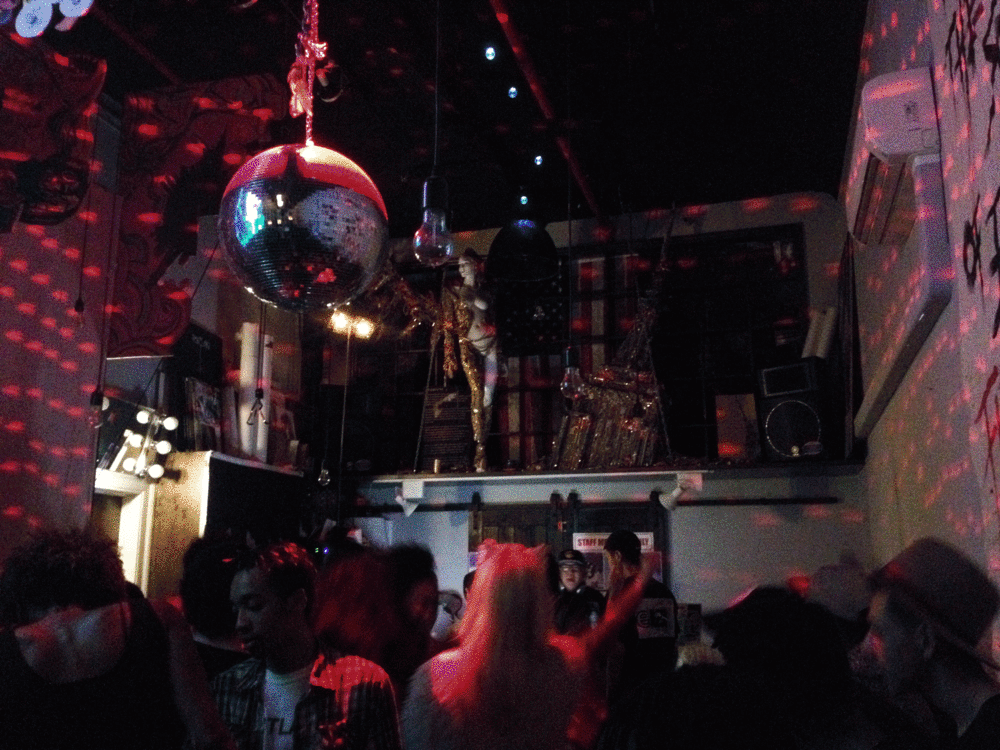
Photo by Paul Chun

New York City – a city of 8 million lonely people
 

data-animation-override>
In New York, everyone is trying to chill by themselves. Our goal is to bring everyone together.
— Andy K. of RSVK


image-asset-3281966

The best Integrated Design thesis from Parsons I’ve seen. Possibly one of the best Parsons thesis projects ever. They didn’t just have a design and plan for bringing people together. They brought different people from different passions and design professions together. A creative and collaborative night.

RSVK – Raw Standard Vision Krew – is an artist collective & recording label based in NYC. Their talent hails from across the USA and the world.

Hosted by Parsons Strategic Design and Management.


image-asset-4877799

This year’s conference will be driven by the  question: What Can Design Intelligence Do? Through the immersive day-long experience we will explore these questions from various perspectives and sectors and through the course of the day have the opportunity to talk about design in the context of new economics, new models, and new work.

The second annual Design Intelligence Conference hosted by Strategic Design + Management will feature: 

10 – 11:00: Registration, Greetings and Light Breakfast

11:30 – 12:30: Panel Discussion

Design Intelligence: What can it do? Exploring the power of design thinking approaches across multiple sectors. Overview: The session will focus on a discussion about design thinking and industry specific applications. There will be multiple panelists, each from a different sector and one to two student voices to have a conversation about how design thinking touches their work and the power of using this design intelligence when tackling complex issues across industries.

Panthea Lee: Founder + Principal, Reboot

Chelsea Mauldin: Executive Director, Public Policy Lab

Allison Samuels: Professor & Field Mentor, CUNY Baruch

Randy Plemel, Design Lead, IDEO

Laura Simao, SDM ’15

Tommy Fadoul, SDM ’16

Moderated by, Alice Krenitski, SDM ’15

12:30 – 1:15: Lunch

1:30 – 3:00: Workshop Sessions (pre-registration register for a workshop here—space is limited)

Workshop: Beyond the Brainstorm

The brainstorm is a heavily leaned upon “creative method” for soliciting ideas from groups. Often, however, once the brainstorm is finished the group does not have the tools, tactics, and methodologies to move beyond ideas. Using design thinking methodologies, we will practice ways to prioritize information, combine and build ideas, and have teams adopt a shared vision so that they can move toward action.

Facilitated by Karen Jackson, SDM ’15, Director of Experience Design and Strategy, REACH Strategies

Workshop: Humanity at Scale: Designing People-Centric Organizations

Many companies focus on delivering a great experience for their customers, while internally, they struggle with poor communications, complex processes and confusing self-serve experiences. How might we apply design thinking to these challenges, which intersect human resources, operations, technology, environment, culture and ultimately, employee engagement? Through this co-design workshop, we’ll explore some of these issues and generate possible solutions.

Facilitated by Elizabeth Enck, SDM ’15, Director of Strategy, we are experience

Workshop: Cultural Design 

Every organization had an identity – whether it has been purposefully crafted or has haphazardly come into being. An organization’s identity manifests itself in two ways – as a brand, and as a culture. This workshop will explore what it means to design for culture: we will look at the importance of culture across human and business factors, build frameworks for understanding and exploring culture as it exists in our organization’s today, and practice pulling the levers that can lead to impactful culture change. Throughout this journey, we’ll utilize our design toolkit and explore how human centered design can create powerful and engaging cultures.

Facilitated by Andrew Hutton, SDM ’14, Consultant, Accenture

Workshop: Design Intelligence for New Venture Design

This workshop explores the role of the design strategist within highly innovative entrepreneurial contexts. Using a macro-scale view of social trends, economic forces and technological advances, we will explore the use of design strategies to create breakthrough products, services and business models. Topics covered will include trend mapping, product development and innovation strategy.

Facilitated by Victor Angel, Co-founder N8 Innovation Studio, SDM ’14

Workshop: Role of Design Thinking in Technology

How do we converge the creativity of design with its functional role in enhancing business strategy? Technology enacts as the medium in which the role of design thinking impacts the process, providing business solutions that will innovate our global economy. Through the workshop, we will explore how to position client’s business challenges and how creative technology is used to unravel its complexities and build financially sustainable solutions.

Facilitated by Esther Ahn, SDM ’14, Senior Strategies, Digital Engagement OgilvyOne Worldwide

Workshop: Communicating Design Intellicence 

How to communicate what can design thinking do for the users that are not aware of its potential? How can you, as a designer, communicate what needs you can address and the value you can bring? This workshop will focus on the problem areas in communication and matchmaking between innovation professionals and the first-time users.

Facilitated by Henryk StawickiSDM ’15

Bruce Nussbaum’s lecture on Design at The Edge is one of my favorite.I’m not enrolled in it, but still feel obligated to sit in every Monday. Last week, Bruce mentioned to me that he is writing a book on what he calls CQ, or Creative Intelligence.

At Columbia Business School’s China Business Conference, I introduced myself as someone in Service Design. A professor from Columbia respond with “Oh look at my tie.”

I may have felt somewhat like IDEO’s David Kelly when at a restaurant he introduced himself as a designer and his hostess asked “So what do you think of my curtains?” (1)

The Columbia professor did zone in on what I mean by design when he said “I’m sure there were many processes involved in creating the tie from Chinese silk, French pattern to be made in America.”

This shows the gap between D-School to B-School that I traverse and that Bruce is helping bridge.

Bruce notes that the framework of Design Thinking, that “collection of behaviors is the heart and sole of creativity. It includes being attuned to the people and culture you are immersed in and having the experience, wisdom, and knowledge to frame the real problem and–most important of all perhaps–the ability to create and enact solutions” (2)
But he poses the question in his new blog post on Fast Co Design about what creativity is and how can we measure it.

If CEO’s have used Design Thinking as a process trick, how can we help develop the ability to convey creativity without making it a process trick? Why would we put creativity on a linear scale alongside IQ and SAT scores?

I agree that Design Thinking has opened the doors for creativity to wider application, but since it was “packaged as a process” it has begun to “actually do harm.”(2) If we take creativity and boil it down to not just a package, but something on a linear scale, how do we keep it’s veracity?

IQ stands for Intellingece Quotient and therefore CQ, Creative Quotient. As quotients are the result of division, why abstract Creativity into dividable dimension? It would be a very efficient way to rate and process individuals. But since “creativity emerges from group activity,” how do we effectively measure the capability of an individual’s ability to interact in a group and frame problems?

CQ will need to contain multiple dimensions.

How do we frame the and show an individual’s “experience, wisdom,” and ability to frame?

One thing for sure is that the model of a psychologist asking pre-defined questions and timing a subject’s arrangement of colored blocks won’t serve as the way for measuring creativity.

Howard Gardner said that when in China, students tell him “Now we have 8 things to be good at,” referring to his theory of Multiple Intelligence. (3)

[singlepic id=515 w=375 h=500 float=left]

Bruce’s dream is that when his godchild applies to”Stanford, Cambridge, and Tsinghua universities. The admissions offices in each of these top schools asks for proof of literacies in math, literature, and creativity. They check her SAT scores, her essays, her IQ, and her CQ.” I envision the admissions office will spend more time viewing the CQ than the other deliverables. Not just because it is the most engaging, but that because it is the most complex measurement and deepest deliverable. It might be like a portfolio with statistics, visuals and maps. Everyone’s CQ will be as unique, if not more than an admissions essay.

I’m in the process of developing a deliverable to show my Creative Intelligence after a course with Carlos Teixeira and Robert Rabinovitz.

I appreciate if we could measure degrees of creativity and am excited to see how the concept of CQ forms.

Bruce at his Design At The Edge lecture series.

2. Bruce Nussbaum – “Beyond Design Thinking” Fast Company

1. IDEO’s David Kelley on “Design Thinking” Fast Company

3. Howard Gardner. Presentation, 2010.

Bjarke Ingels spoke at Parsons and presented his amazing works as well as a vision for the future.[singlepic id=646] See chunked notes for details.

Bjarke Ingels
proposing that we’re “not designers of 2d or 3d objects” but rather “designers of ecosystems” that
“channel not only the flow of people, but also the flow of resources through economy and ecology.”

Hedonistic Sustainability
dragon symbolic of China
swan of Denmark

Comparison between Shanghai and Copenhage
relating Shanghai to Copenhagen, but Shanghai is not your typical Chinese city and has a history of being cosmopolitan with it’s large expat community and growth from a port city.
[singlepic id=642]
World Expo
collaboration with Ai Weiwei on the installation of the “Remote” installation for Little Mermaid

  • -Environment
    -temperature, natural airflow “creating a draft”
    using evaporative cooling from the pool inside
  • -Energy
    “entire system spent less energy than the coffee machine”
    “half art and half architecture” emphasis on how to “increase art quality”
  • -Tony stark’s mad science expo (using a similar image as the first photo of the Danish Pavilion from the world expo)
  • “If hollywood starts ripping off sustainable architecture,” maybe “we’re moving towards hedonistic architecture”

  • Designing for Personas and Psychologies (my words)
    You can bike thru the whole thing in 2 minutes w out missing a thing.
    It’s like desinging for Type A and Type B personalities
    [singlepic id=648]
    Architects
    “Architects are @ the center for [discussing how] to redesign the service of our planet so that it fits the way we want to live”[singlepic id=643]”The public discourse [has architecture] reduced to contemplating the final results”
    Maybe it is about process, process to build and post build, process to exist…instead of perish.

    He looks at “coming back to the way the building is created for people.”
    [singlepic id=649]
    Yes is more
    “Less is more.” Mies van der Rohe – minimalistic aesthetic
    “Less is bore.” -Robert Venturi
    “I am a whore and am paid very well for building high-rise building.” – Phillip Johnson
    [singlepic id=660]
    Evolution
    “Rather than revolution against society, … evolution with society”
    [singlepic id=669]-Drawing Darwin’s evolutionary tree

  • evolution
    “a process of designing through excess in each generation.”
    “a functional model and beautiful model”
    relating each evolutionary iteration to a “design meeting.”
  • subspecies that spin off.
    his studios never throw anything out.
    it’s an archive of architecture biodiversity
    you never know when [a previous project can be the answer to something new]
  • [singlepic id=652]
    Architectural Alchemy
    Similar to Jason Severs of frog reffering to some clients viewing design as “the dark arts” (see notes), and Valerie Casey of Designers Accord noting “the myth of designers as magicians” (see those notes)
    I am seeing that as a theme that keeps popping up in presentations, the mystique behind, or rather infront of, design.

    Project in Denmark
    “Lively and diverse when you’re building a city from scratch”

    New York
    a vision with “an oasis in the city”
    [singlepic id=659]an animation of what New York can look like in the future.

    Public Participation
    he notes most of his work is private commissions

  • ex 1: project for the Danish maritime museum
  • ex 2: city hall in capital of Estonia
    [I hear the US Embassy there is a palace.]
    [singlepic id=664]
  • created a “public service marketplace”
    -it contained 11 different departments – so they created a prous organizattion
    [architecture based off of the organization]
    -condensed village of public administration
    -the roof “invites the citizens” into what looks like a roof top lounge.
    -instead of a tower they proposed a “political reflection”
    -containing a giant mirror that shows an overview of the city
    -this “democratic parascope.” also allows the people outside to see what the politicians are doing inside.

  • work in Kazakhstan
  • “linear library – the ideal sturcture”
    “so a circle combines linearity with efficiency”
    “a continuous loop of public programs warpped around an ideal archive”
    the exterior was created to be a mobius strip
    somewhat resembling the Yurt of the Kazakhs
    the center of which is a coutaryd which is entered before you enter the actual library.

    when meeting with the president they saw a work of contemporary art that looked errily like their proposal.
    “rational and rigorous argument to create the most compelling argument”

  • greenlandic national art museum
  • on the waterfront of Nuuk, the capital city
    a loop that receives an imprint of the ground it sits on.
    “integrated withe the nature and the topography”
    the presnts an “unfoled section” view showing a singley linear view
    [realtes to concept of time experienced through a subjective path]

    The  Big Picture
    [singlepic id=667]Loop City
    “what we need to do is not focus myopicly on the danish side, we need to focus at the Swedish side..”

  • “A holistic master plan”
    “We can connect the most desnly polulatted part of metroplitant scandifanvia” which also an area under extrem growth.”
  • Binational metropolitan region connecting universities, resources.
  • [singlepic id=666]”The same size as the San Francisco bay area”
    [singlepic id=654]”The train system serves as an an energy spine for charging electric cars” (which are tax free in Denmark costing a 3rd of normal cars)”

  • Energy infrastructure
  • Social infrastructure
    [singlepic id=655]synergies – ex: excess energy from industry becomes heat for the public baths.

    A waste to energy plant
    [singlepic id=673]
    Since there are extreme sports like race-carting around in the vicinity, BIG proposed a ski resont ontop of the power plant.
    You can use normal ski equipment on a to allow for a “hybrid of bikini skiing”
    In the winter snow can be “created by blowing air [or moisture] through the system with no energy
    expense.”
    Excess water is drained thru the facaces to fill planters on the windows.
    He then presents the initial vision [see fist cellhpone pic] to design cities as ecosystms of buildings.

    The chimney smoke isn’t toxic, but does have CO2. 1/10ths of a ton of CO2
    “One of the main drivers for behavoir change is knowledge.”
    “If they dont know they cant act.”

    Pragmatic Utopia
    “Economically and ecologically sustainable”
    “You make it socially sustainable because it gives the city a public space and social function that would otherwise be nonexistent.”
    “The vision of future cities.”
    “Pragmatic utopian master plan for the future.”

    This is the slide he opened with, as well as the slide he closed with.  I think effective presenters plant a seed a the beginning of the talk and then refer back to it at the end.  This allow them to loop to a conclusion that you already knew but has grown.
    [singlepic id=671]
    [singlepic id=672]packed house.
    [singlepic id=674]more than 970 slides

    More
    Bjarke Ingels Group – http://www.big.dk/

    Many of his projects he presented you can see on TED.

    Other pieces presented:
    the parking + apartment peice in Denmark
    -“the facade turns into a rasterized image by the holes drilled into the aluminum”

    Thoughts
    As an architect he looks at multiple domains to develop metrics to create qualitative experiental and places. That is something most service designers don’t do very well.

    Space is gorgeous, has an emotinal impact.
    Service design we don’t place emphasis on the changing the physical space.
    So there is a need to emphasise the emotion of the experience.

    Q’s
    [singlepic id=657]What more can we do?
    How unsustainable Chinese architecture and development is
    The emphasis for China to become a consumer culture.
    Green Energy in China. [my general Q’s to expand on]

    Guest Lecture by Bjarke Ingels at Parsons
    Original event information:
    March 10, 2011 6:30pm
    Kellen Auditorium
    Sheila Johnson Design Center
    66 Fifth Avenue
    [singlepic id=640]Thanks to SCE
    The MArch program presents a lecture by Bjarke Ingels of BIG- Bjarke Ingels Group. Bjarke Ingels started BIG-Bjarke Ingels Group in 2005 after co-founding PLOT Architects in 2001 and working at OMA in Rotterdam. Through a series of award-winning design projects and buildings, Bjarke Ingels has created an international reputation as a member of a new generation of architects that combine shrewd analysis, playful experimentation, social responsibility and humour. In 2004 he was awarded the Golden Lion at the Venice Biennale for the Stavanger Concert House, and the following year he received the Forum AID Award for the VM Houses. Since its completion, The Mountain has received numerous awards including the World Architecture Festival Housing Award, Forum Aid Award and the MIPIM Residential Development Award. Recently, Bjarke was rated as one of the 100 most creative people in business by New York based Fast Company magazine.

    Original event information via: http://sce.parsons.edu/2011/03/04/guest-lecture-bjarke-ingels/

    [nggallery id=54]

    DESIS Lab Presents
    Service Design Performances – Spring 11 Series
    SERVICE DESIGN: MORE THAN THE SUM OF ITS PARTS
    With Andy Polaine
    Date: Monday, February 14, 2011
    Time: 6:00 to 7:30pm
    Location: 80 5th Avenue, 8th Floor, Room 802, NY
    Service Design is more than the sum of its methods, blueprints and customer journey maps. In this talk Andy will explore the mental move from an industrial, product-fixated mindset to a service-oriented one. He will explain the four spheres of people, networks, experiences and resilience are the core of service thinking and the glue that holds together the more recognisable touchpoints. Andy will also examine the boundaries of service design and design thinking when dealing with complex areas such as public services and even international peace, security and development.
    Dr. Andy Polaine has been involved in interaction design since the early 90s and was co-founder of Antirom in London. He was a producer at Razorfish, UK and later Interactive Director at Animal Logic, Sydney. He was Senior Lecturer and Head of the School of Media Arts at The University of New South Wales, Sydney before moving to Germany and is now a Lecturer and Research Fellow in Service Design at the Lucerne School of Art and Design in Switzerland. Alongside his academic work Andy continues to work as a interaction designer, service design researcher and is co-writing a book on service design for Rosenfeld Media along with live|work co-founders, Ben Reason and Lavrans Løvlie.
    [singlepic id=531]
    Service Design Performances is an immersion experience in design for services, bringing together international professionals and scholars to present their work as well as presenting current and future areas of service design teaching and research at Parsons SDS.
    Design for Sustainable Social Innovation and Sustainability (DESIS) Lab is a research lab at the School of Design Strategies, Parsons The New School for Design. Its mission is to advance the practice and discourse of design-enabled social innovation toward more sustainable cities. DESIS Lab conducts research into the ways in which design can enhance community led initiatives in the development of more sustainable ways of living and working. In particular, DESIS Lab uses Service Design as a means to apply design expertise into problem setting and problem solving related to sustainable practices and social innovation.

    via School of Design Strategies at Parsons The New School for Design

    See Andy Polaine’s website here and twitter here.

    Sunshine GenerationBruce Nussbaum brought Ziba’s Karen Reuther and founder Sohrab Vossoughi to Parsons on Monday the 7th. They open the presentation with “The revolution is underway.” The presentation was based around the “Sunshine Generation” in China, young urbanites that grew up not knowing Tian’anmen’s square and have only seen economy growth.
    [singlepic id=519]
    Karen Reuther of Ziba says “They call themselves sunshine because they are smiling”
    Some of what was presented can be related to the article “Oh, to Be a Millennial in China,” by AdAge in 2010.

    Ziba developed a few findings from their ethnographic research.

    1 the youth are comited,
    their weapon is optimism

    2 the shift is radical,
    and it is happening from the inside out
    they see china influenceing the world.

    3. the scale is unprecedented
    w 340M ‘revolutionaries’ participating

    One of their main insights was
    They are more similar than different (with us)
    Unbridled Optimism – “I don’t just want to follow what others are doing. I want to do it myself”
    they like to “look different together.”
    Anticipating Greatness – “My generation likes challenges. We want something unexpected.”

    I will post more on this later, including my views in relation to my experiences in China.

    [singlepic id=515]
    [singlepic id=517]
    [singlepic id=520]
    [singlepic id=521]
    [singlepic id=522]
    [singlepic id=523]
    [singlepic id=518]

    More about Ziba here: http://www.ziba.com/


    This lecture is part of Bruce Nussbaum’s Design At the Edge lecture series.

    DREAM:IN ConclaveTo read the common dreams of India and develop big ideas for business, policy, development and sustainable change, and work towards realizing them, leaders and design experts from India, USA, Brazil and Italy will be joining us at the conclave from 16th to 19th February 2011. The DREAM:IN Conclave will bring together 55 national and international leaders to share a vision for India through design. During 4 days in Bangalore, the knowledge center of India, thousands of Indians’ dreams will be interpreted by entrepreneurs, business leaders, design and creative thinkers, venture capitalists, policy makers, and financiers to design transformative changes for India. Dream Volunteers consisted of students in design, anthropology, marketing, finance, technology, urbanism will synthesize and broadcast through the DREAM:IN Portal the visionary scenarios and opportunities for investing in India’s prosperity. The DREAM:IN Conclave works towards bringing global design expertise to fulfill common dreams of locals. With an open source database of dreams, visions, and investment opportunities India will be ready to change the lives of people locally and globally.

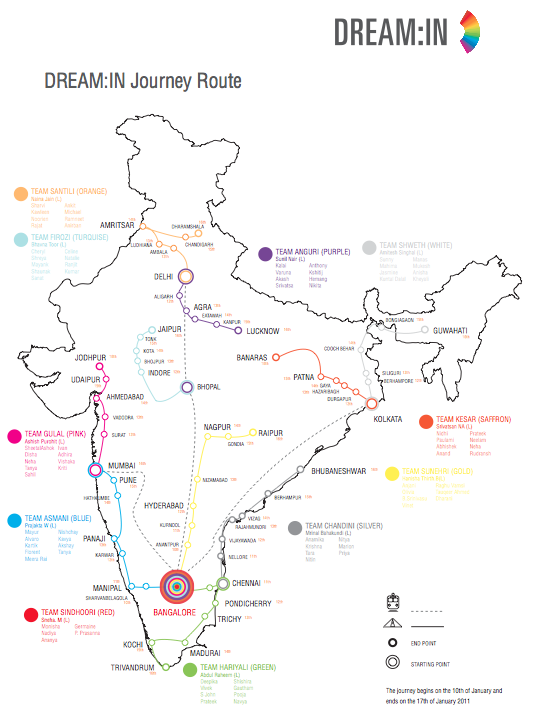
    dreaminjourney-7034567


    Connect with DREAM:IN
    Twitter:
    http://twitter.com/#!/DREAMIN_Team

    Facebook:
    http://www.facebook.com/dreaminteam

    Vimeo:
    http://vimeo.com/dreamin

    Flickr:
    http://www.flickr.com/photos/dreaminteam/

    See below for more details on specific phases

    DREAM:IN
    Collecting India’s aspirations as a canvas for creative thinking
    Challenging the notion that future thinking should be informed by people’s needs – the DREAM:IN initiative seeks to explore what Indians are dreaming about. It intends to create a dynamic database of dreams gathered in cities, towns and villages across the country. These will be categorised, analysed and shared with business leaders, educators, social entrepreneurs, policymakers and designers to devise transformative and inclusive future scenarios. DREAM:IN intends to collide the dreams of a diverse India with the thoughts and actions of leaders across a range of sectors.

    DREAM:IN Journey
    8-17 January 2011
    101 dreamcatchers have been selected from students from over 20 Indian institutes of management, design, communication and film. They will be dispatched in groups across 11 itineraries which traverse rural and urban India. Along the way they will be questioning locals about their dreams and aspirations – for family, work, recreation, products and services – and capturing these on video. They are expecting to collect over 10, 000 dreams. Before heading off they will receive training from a team from various backgrounds including ethnography, education, advertising and cinematography from across India plus Brazil, Italy, New Zealand and the US. This group features professionals from Nokia, Ogilvy & Mather and Parsons the New School for Design (New York). The findings will be returned to the DREAM:IN headquarters in Bangalore to be collated and categorised ahead of the conclave.

    DREAM:IN Conclave
    16-19 February 2011
    February’s summit will bring together a selection of students, educators, policymakers, social entrepreneurs and professionals from sectors such as finance, IT, retail, telecommunications and energy. Participants include powerhouse retail entrepreneur, Kishore Biyani and Fast Company’s Bruce Nussbaum. Findings from the dream journey will be shared through a series of workshops. These will be used to inform future scenarios via a rigorous design-thinking methodology – with the view to devising concrete projects to effect fresh thinking around delivering products and services at scale.

    DREAM:IN Portal
    Feb 2011 onwards
    An open portal will be launched which allows users to upload and categorise dreams by sector – adding to those collected on the dream journey. These will be supplemented by scenario building tools to assist professionals to translate the dream database into insights which can inform their future strategies. Drawing on the larger canvas of dreams over needs is expected to fuel enhanced creative thinking.

    The DREAM:IN project has been driven by Idiom Design and Consulting in Bangalore and their design education initiative SPREAD. Inception and direction: Sonia Manchanda, Idiom. Enterprising design knowledge and global markets specialist: Carlos Teixeira, Parsons the New School for Design. Supported by IBM, Manipal University and Mr Kishore Biyani.

    Source: Updates on the DREAM:IN Journey_Bangalore, India email from Carlos Teixeira.

    Earlier this year DREAM:IN, an international inititative was started by Carlos Teixeira and Sonia Manchanda in conjunction with idiom and support by Bruce Nussbaum.  See below for original details.
    DREAM:IN is a platform for engaging local design expertise globally.

    The DREAM:IN Project challenges one and all, to begin the creation process, not from people’s needs but from their dreams. To share dreams, to create big ideas that help realize dreams. And to bring ideas to reality, leveraging networks, with skill, speed and imagination. The DREAM:IN project is the creation of a set of design thinkers across borders. It is designed to challenge us to create not for people’s needs, but for their dreams. Its time to get greed and need out of the way and create common dreams. In India, is it the time to unlock dreams, the dream of every common man, woman and child.

    We are inviting students, faculty, design experts, entrepreneurs, artists, venture capitalists, activists, business leaders, not-for-profit agents, government leaders, and who ever else would like to:
    a. apply user-centered design to collect and interpreted the DREAMS of people in India
    b. play the role of a knowledge broker to transform DREAMS into projects with economic, social, cultural, territorial, and environmental value
    c. explore new ways of enterprising design knowledge through open innovation systems and global networks based on local expertise
    d. imagine new ventures based on new types of organizations and business models
    e. transform DREAMS into tangible realities

    Connect with DREAM:IN
    Twitter:
    http://twitter.com/#!/DREAMIN_Team

    Facebook:
    http://www.facebook.com/dreaminteam

    Vimeo:
    http://vimeo.com/dreamin

    Flickr:
    http://www.flickr.com/photos/dreaminteam/

    Youtube:
    DREAM:IN Youtube Channel

    idiom-8866797
    idiom design consulting

    Source: origional event email from Carlos Teixeira (Parsons The New School for Design profile) and NODES (http://spread-design.blogspot.com/ )