John Ryan of Local Projects
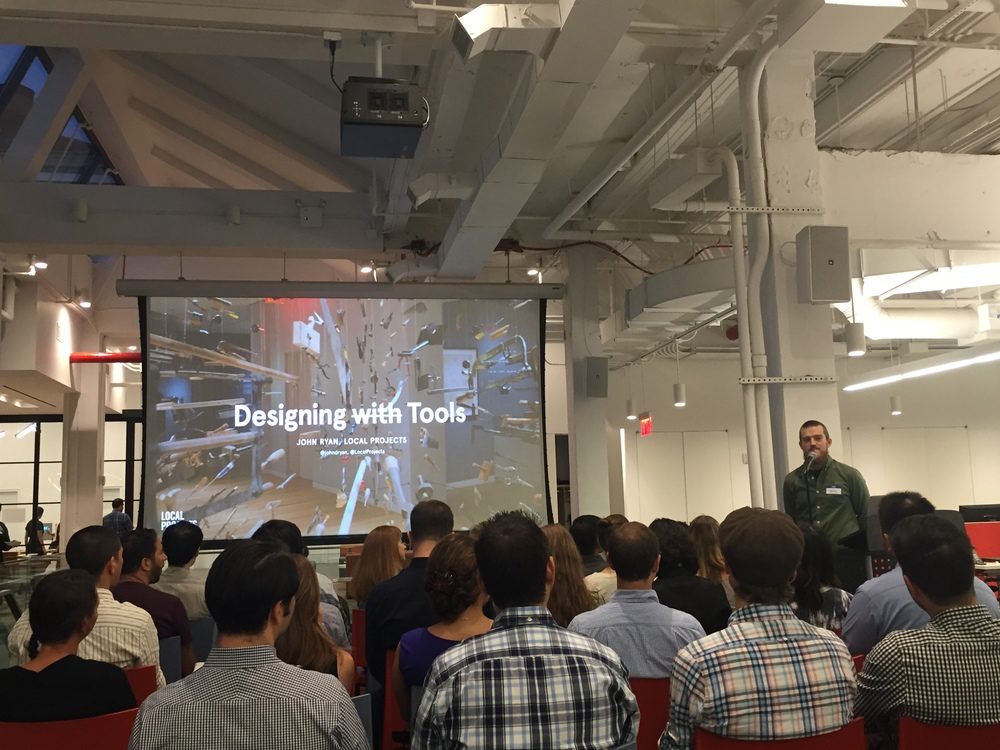

image-asset-2542199

We engage in tool making
     – the lens of this presentation

The most successful design in history     
     – Andalusian hand axe – 
     when measured by project life cycle

“The most significant step that ever was taken in human history, the thing that …”

The things we make … what we leave behind…
     the way that puts design as one of the oldest disciplines as humans

went beyond functional – social expression, cultural – people got attached to them,

     in a way they captured the human desire to express, embed ourselves in our surroundings, change objects around us

     we picked up the piece of charcoal afterwards – we started scwaling on the wall
we embed narratieve  – “THE UNIVERSE IS MADE OF STORES, NOT ATOMS”

     TOOLS – Invited self expression
     tools invite people to create their own experiences – to make their own meaning.

—-
     Cleveland Museum of Art

keen to leave space for visitors own experiences 

simple tools design to amplify the experience of being in the gallery
     – not to take you somewhere else
     – you could totally ignore it or engage w/ it
     – the successful ones built on self expression


Self expression – facial recognition to showcase artwork making the same face as you
     gets at the heart of portraiture – the ability to engage remotely and abstractly

Gesture recognition – figurative sculpture
     making the pose key to what art is trying to say
    allow visitors to connect w/ it
     a simple game = select a sculpture, try and imitate it – rated on performance
     people of all ages connected w/  it in a new way to look t the wok

central piece – wall collection of 3k artworks
     tool for connecting w/ the size of the collection
     and engaging w/ the curatorial collection / method
     browse the artworks, save those that interest you.
     a platform to make your own experience

Tools
Elegance candor and purity – American photographer Walter Evans – summed up common tools
     a lot of us are obsessed w/ our tools
     “what’s the latest tool that’s going to save my project?”
     tools have that explicit in their form and their design     

Bret Victor
     “tool – that which address human needs by amplifying human capabilities”

Prehistoric man – need to eat, sharpened rock, spear – leverage our abilities
     this primitive task – is at the core of our design process
     take what ppl need to do, amplify what they can do
     make the impossible possible

Great tool are designed to fit both the capability and the need
     The person and the problem (handle hammer head)

a lot of ppl wanna use technology for technology sake
     we want to make it disappear
     so it feels like you are just using your own capability
     you forget the hammer is there, it becomes an extension of you
     optimize for both parts – and in a way cause it to feel natural and disappear
     amplify capabilities in a seamless way

Cooper Hewitt National Design Museum

1
     come up w/ a visitor technology that emphasized play
     we weere collectively thinking about this need
     set an expectation for the visitor that they are here to design, here to make, not just consume?
     what tool could we equip them with based on their capabilities

     The Pen
          learn about design by designing, themselves
     the whole experience was built around this one tool
     bookmarking system, stylus, antenna to store info
     ppls desire & ability to create = amplifies it
     puts you in the middle of the design process

arrive @ museum – get pen & ticket – collect inspiration w/ pens’ RFID reader as you move around the museum – touch down on LCD table  and all of you info spills out – explore central river of insertion on table – explore any artifact w/ one line and see where it connects – k

also a tool for making
     inspiried by the collector around you, then design your own w/ the pen
     use the pen to save it

I think they’re moving towards bien gamble to create your own design by printing it in 3d

2
What happens if visitors get so caught up in what they’re doing, they want to draw all over the wall
     created the Massive wall paper room
     see in context,on the wall , not just on the screen
          create a pattern, move it, transform it
     became the ultimate selfie station – wall paper Wednesdays when the museum reposts people’ selfies

based on the need and ability everyone has – taking it and amplifying it

Museums
Education & Storytelling as what they want to do
     factory model of education
     rote memorization, kids remember and are forced to repeat

activity based learning is the best way to get ppl to learn and remember

[Confucius Quote]

We make tools and innovational experiences bc we as humans – this is how we understand things

     tools invite self expression..

NY hall of science
     digital noticing tools for math & science
     didn’t want an overly didactic experience
     tools so children could explore math and scion around them
     programs @ the museum that do it in a really physical way
     encourage kids to make and play
     go thru that to create virtual set of tools in middle school classrooms

Series of app
     one  – in physics lesson – bored, staring @ playground , their next spot during the break.
          but when they’re in the playground they’re enacting much of what they learned
     how could we create an app to allow children to discover and explore these things themselves,
          how we use hardware
     prototyping and iteration
          using physical hardware – matts of different materials – see how frictional forces we effected
               matts of diff material feedback to an iPad
          hardware difficult to scale  – esp for a design stdio not building a product
     one designer quickly made a proof of concept – the phone is recording movement while moving & jumping around – visualized the data over the video
          built in more complexity
          a prototype that would talk – create network btw phone & video,  -0 see dat underneath – xyz movement access,
          use computer vision (camera) to track & record the movement
            &nbsp
;      instead of automatic video tracking (kids have eyes and are good at that)
               allow kids to trace the movement path
          move concept forward and simplified 

This product made a brief appearance in Tim Cook’s latest Apple keynote

changed how the kids engaged

——
We shape our tools and thereafter our tools shape use – father john culkin / marshal mcluhan?

Sarah ____________ – [design inspiration]
Skate boarders & wheelchair users
     hack the city & reshape the environment
     to make the city work better for themselves
tools shape our understandings & perfections 

——
Age of wearable devices & qualified self
     how we understand the world around us & how we understand ourselves
     feedback loop to understand ourselves and get in shape
     i don’t think we’ve quite yet understood how it’s going to play out

Tech museum of innovation in San Jose
one exhibit at the core
     iPod touch that hung around their neck
 + brain monitor – skin galvanization – moisture reading
     move around the museum, amazing place for kids, physically you can see the feedback of the sensor on the device itself (and the artefact of the installation)

at the end of the visit, bring your devices to touch table your data comes flowing out of it
     the course of your visit, how you respond spending on what you were looking at, compare to those around you, 

——

We’re all eager to put our hands on the technologies and potentials
     a necessary one – figure out what these tools mean for us
     this potential of augmenting ourselves and shifting how we know ourselves and the world around us

     tools are intended to bring about change
     we continue to make and use them out of a deep human desire to go beyond our current abilities

get the technology out of the way so they can amplify they own voice
take a desire or spark….bring this potential to life

     facilitate learning, so by doing, we understand.

     and they shape us, we shape our tools, and there after our tools shape us, the ways that we perceive and understand the world around us and ourselves 

presented @ Cooper Hewitt side by side: hand axe & iPhone – majorly influential objects 

     the best tools allow us to embed ourselves in them, they become symbols of us, the hand axe becomes to something metaphorically that has our hand and the form that they choose to represent ourselves in

invite us all to create tools that allow ppl to embed themselves and express themselves 

     tools that allow us to move beyond our current limitations, to allow perspective to be changed, to allow users to do wonderful things to them
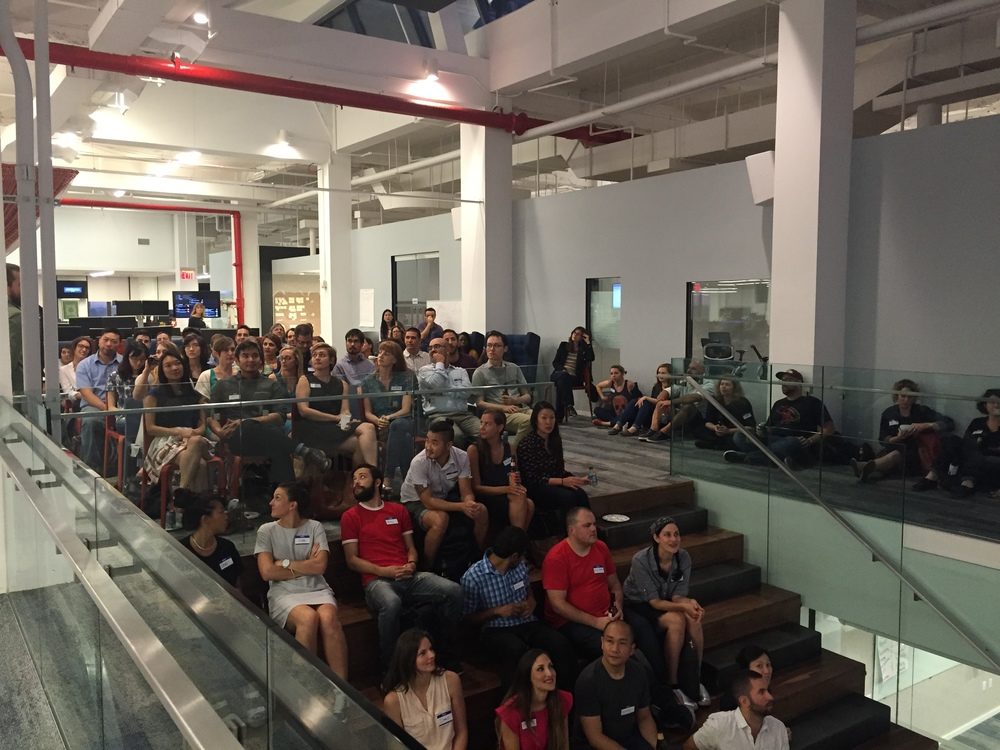

image-asset-8689237

the full house at Yodle’s new office space

Questions
Sustained engagement when you’re not creating a whole platform or whole service
     @ Cooper Hewitt >1/3 of visitors returning online to check their visit

User testing early
    and to as full of a prototype as we can
     when we don’t do it, it usually bites us later

Long term maintenance of these types of experiences
     – on going support w/ most institutions
     a lot of back and forth w/ their internal IT department

     ex; Museums of San Jose – experienced IT team so it’s usually a partnership btwn us and the client themselves 

Diff w/ Local Projects – we don’t do many one off marketing experiences where it’s up for x hours, ours are up for years and years. ex: we can’t just use any screen off the shelf


How to Design Interactive Physical Experiences?


Event date:
September 17, 2015 – 5:30pm – 7:30pm

Location: Yodle Headquarters
330 W 34th Street, 18th Floor
New York, NY
United States
Groups: New York IxDA

Event description: 

“Creating an immersive digital experience is a hard challenge that designers take on daily. However, there are select projects that go beyond the screen and bridge over to the physical realm. With breakthrough technologies within the Internet of Things (IoT) and brands reinvigorating their retail shopping experience and startups taking their brands offline (e.g. Warby Parker, Birchbox, Bonobos), there is an ever-present need to keep the customer engaged throughout both their digital and physical experiences. And find ways to make both experiences as seamless as possible.

Local Projects will be showcasing specific projects where the design challenge required immediate insights thoughtful planning along with flawless execution from both a research and design perspective.”

Get involved with IxDA
IxDA NYC
Local Project
Thanks to the host Yodle

next IxDA event: October 1st or 2nd – Managing Chao 
Rajesh Bilimoria, Vice-President of Continuum[singlepic id=841]Rajesh presented on some of the current intricacies of how money is used and ways to create new offerings for consumer financial products and services.

Case studies
Rajesh cites case studies like Kenya’s M-Pesa, Visa’s black card (which he says the concept actually existed as a myth among aspirational users before it was a real Visa offering), and the work Continuum did to improve the online banking of BBVA. Rajesh mentions samples of their research process and method of moving from concept works to usability testing in order to validate are the right user tasks can be executed.

Their wireframe was unique, as it highlights the user’s priorities, not just the functional aspect of what it means for BBVA, but what it means for BBVA’s users.
It’s similar to what Monica Bueno presented at the Service Design Conference in Cambridge last year on the visibility of service design hierarchy by a website’s layout.
[singlepic id=849]
[singlepic id=850]
layout shows the importance that the business places on their own offerings and depts.

Context and needs matter. Highlight the opportunity.
“Context and needs of how people live” frame the opportunity. He stresses the discrepancy between priorities, where “what’s important to the company often isn’t the most important thing to real people.” “We have to shift” that way of thinking so that, “the consumers’ focus is our focus.”

  • ex: “Consumers are not after a mortgage, they’re after a home.”
  • [imo Reframing those priorities can make the interaction much smoother when the consultant can let their client know what the client’s consumer expects.]

  • We should strive to create “a  much more humanistic experience even when you’re dealing with something like a mortgage.”
  • “We can easily ignore the complexities of our interactions, but it is these complexities that create the opportunities for real innovation.”
    [singlepic id=840]

    For example, the mobile telecom industry is focused on driving ARPU (average revenue per user). If that is the driving priority of the business, it is does not create a very positive user experience. See more on what Umair Haque dubs “fake costs” in the telecom and banking industries. http://www.managementexchange.com/blog/why-business-brain-dead-and-how-wake

    Experience
    Rajesh places emphasis on pursuing experience as a driver for improving offerings, and revenue.

    Metrics
    I am interested in how you develop metrics for an experience that you’re not yet sure what it will bring.

    New system of metrics
    [singlepic id=847]
    Rajesh mentions “If we just use the metrics we have now as metrics of success, that’s a good way to kill ideas. And if we use yesterday’s perspective and yesterday’s lenses, we don’t give today’s ideas time to breathe.”
    One method is to use experiential metrics that initially framed your prototyped idea. The parameters that define how are you delivering on it can be turned into dimensions for new metrics. That will help the client keep fidelity after it is implemented.

    [singlepic id=838]
    Bruce Nussbaum notes that “a good way to kill innovation is to apply one set of [existing] metrics to a new experience.”

    Application from different domains
    (possibly look into Doblin Group’s Ten Types of Innovation for measuring impact)
    Are today’s measurements relevant to what we are implementing? Another way is to look to a competition’s metrics as well as other domains, offerings that are experientially similay may have metrics that are similar.

  • ex: Netflicks didn’t look to Blockbuster for metrics, but may have looked at
    for different interactions that can provide metrics about what the next ideas is.
  • [Blockbuster did charge a lot of “fake costs.” For example “late returns” used to always charge the renter a fee, but how often did that late return cause a film to be “out of stock.” A title with less copies, but not empty, may actually have helped encourage browsers (people that were browsing) to think that it was a hot film.]

    Rajesh says that “Not that everything in the past that is bad,” but says “starting with experiential metrics as business metrics have to support that.”

    Continuum “looks carefully to understand, think about what things mean, create new ideas that build on our understanding and thinking.”
    Like Jason Severs of frog design, Rajesh also suggests taking the client out into the field. He also notes the importance of story telling. This isn’t just used to show the client the existing conditions that a user encounters, but also envisioning a future scenario.

    ———————

    Organizations
    An increasing part of our work is figuring out how an organization needs to adapt.
    Nothing can kill an organization that is advserse to change.

    Embrace Complexity
    SImplifying problems can help us meaningfully address human complexity and our world.

    [singlepic id=843]

    Rajesh’s thoughts on currency

  • People will spend more time and more money to purchase intangible things.
  • Previously , social networks were invisible.
  • [Now there with SNS there’s] the excess of numbers, with connections [potentially] being currency.
  • “In a lot of the luxury [industry], time is currency”
  • “alot of services are around time managment”
  • “quality of life is a metric.” “happiness is going to be a currency”
  • “things of value that are not currecny bc they can’t be traded.”
  • “money is going to be less impotant thatn it has been in the past.”
  • [singlepic id=839]
    CONCEPTS
    for developing a new financial services system for Gen-Yers
    “It’s not the saving that’s hard, it’s starting the habit of saving that is hard.” – Rajesh
    “And it’s reducing your debt” – Bruce
    Rajesh spoke about the concept of a model where instead of a service offering a you a deal to pay and recieve something (Groupon-eseque), you may get a deal for future (with investment appreciation).

    My thoughts on the presentation
    While the main case study, BBVA, was a website, I really appreciate Rajesh speaking about experience outside the context of just web and digital services. He did not even have to specifically define that he was talking about people, users and their lives. He framed the presentation well and spoke broadly with specific examples where the main points were about human behavior. Even when showing the case study for BBVA, he showed research photos of user’s physical desk setup, videos of users engaging with digital prototypes and images of users working with paper prototypes.

    I am excited to see what design consultancies can offer in terms of service design and designing pathways for experience that are not solely web based.

    [nggallery id=63]


    This lecture is part of Bruce Nussbaum’s Design At The Edge lecture series.
    additional
    [singlepic id=846] mapping user habits

    I was impressed by my little brother kludging his mobile to his dashboard. We had the GSP nav running as well as Pandora.[singlepic id=596]

    While cruising to DIA, all of a sudden the car asks, “Do you want to preform a systems check? To cancel, press ‘OK’.” In an androgynous version of HAL, the voice sort of freaked me out. My little brother said “No, I just took it in last week.” My response was, “Why is the car talking? And why does the car have an “OK” button? This is not ok.”

    I thought Don Norman would be displeased.

    [singlepic id=597] It turns out the “Ok” button is also the play, pause, and tune button as well as the volume toggle. It just happens to be one of the furthest buttons from the driver.

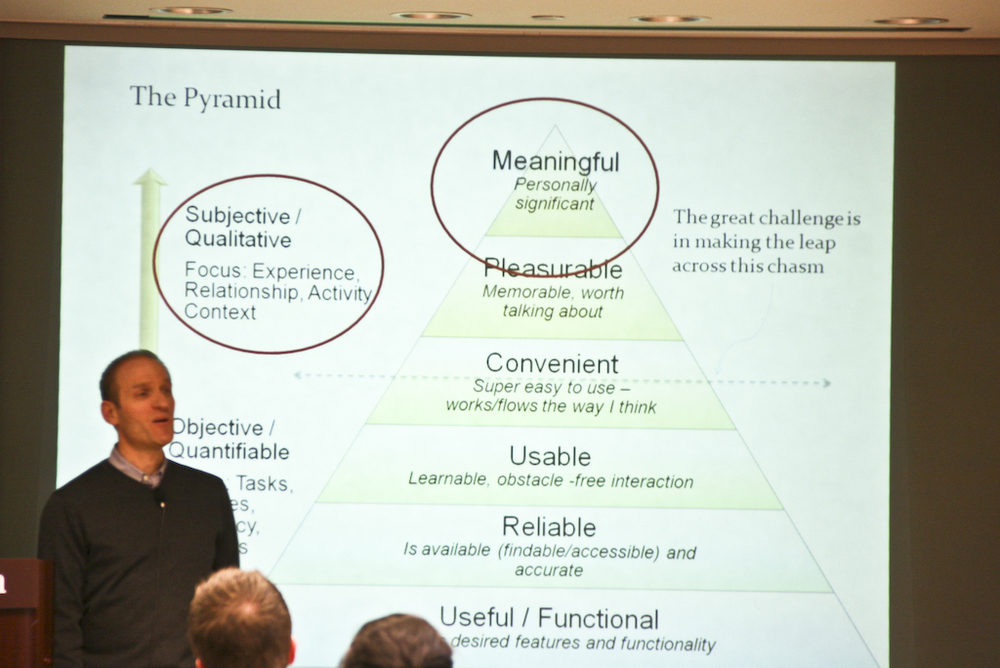
    Pyramid (inverse pyramid of accuracy on top)
    “The automobile industry is copying all the worst features of the computer industry, ignoring all the advances in user-interface design” (Norman)

    But as you try to create meaningful experience, the content is more more subjective, the ability to be effective is based off of different criteria.
    ixda-kozatch-17-2788339The auto industry is trying to design personal experiences, without first properly addressing usable, obstacle-free interactions.
    Ironically the interruption asking if we would like to perform a safety inspection could in fact be putting someone at risk of crashing. Norman notes “the real irritations of modern communication are those of human attention.” So why is the car emulating a human voice and interrupting you while you drive at 85mph? Shouldn’t there be a threshold – 45+ don’t ask any questions. Or if there is snow on the road, don’t ask any questions. Like mom had “let’s play the quiet game,” while trying to concentrate on driving. Or shouldn’t there just be a feedback loop so the warning system registers that a systems check was already preformed?

    There are many regulations when designing for automobiles, so the threat isn’t so much that the notification was dangerous, the threat is that it the notification was pointless. In this case, the safety inspection was already completed. So the audio warning was dismissed. If the safety inspection was not completed, the audio warning would be dismissed, but there would be no note left behind reminding the driver of the necessary safety inspection.

    Designing meaningful experiences requires an increased emphasis on research before production and as well as heavy user testing.
    [singlepic id=595 ]As the pyramid narrows at the top, it is easier to encounter a higher degree of dissatisfaction as a design is harder to match with peoples’ expectations.
    There is a bigger question than how to refine the interface of a car. Why is there a new car model every year? That question popped into my mind a few years back. It’s often a new shell with out much newer functionality. Pre-Cold War cars are kept well running in Cuba, and probably with a lot better milage than your 2006 model.

    You can see it on the consumer level. Why are there so many marginally different models? It permeates onto its brand image level with the discontinuation of some brands. After the recession, auto companies saw they couldn’t keep pushing superficially new models of every year in a redundant brand architecture.

    On a systematic level, the nation’s capital has a beltway that looks like a parking lot. New York has the best public transportation systems in the United States, but it is one of the worst in the world.*

    The federally subsidized rail system from the nation’s capital to the financial city is horrible. We have problems in the form of single buttons as well as the major veins of these systems.

    Norman closes his piece on IxD for Autos with “Design specifications for the appropriate way to design, given the attentional demands and safety considerations for the driver. Ah yes, but this will have to wait. Work in progress.”

    We should get working.

    *I’m not measuring how effective a transportation system is by the sheer number of people it moves.
    Donald Norman, Interaction Design for Automobile Interiors http://www.jnd.org/dn.mss/interaction_des.html

    Definitions.We shouldn’t let definitions limit our discipline.  Our actions, tools and methods should define our discipline, not vise versa.

    Siloing Definitions
    Apparently in Silicone Valley, introducing yourself as an “interaction designers” denotes that you know how to code. But that on the east coast, it means you are a visual designer possibly without the ability to code.

    Someone else told me that “User Experience” is online, but “Experience Design” isn’t exclusively online.  But isn’t the design of a service also supposed to be user centered? It makes sense that the pathways must be well designed for the provider as well, which is why some companies like Kaiser Permanente prefer the term “People Centered,” since they also design for the nurses that take care of patients.  There is the theory that experience cannot be designed, only the parameters for the experience. But that doesn’t mean outcomes are totally out of our control. We need to influence specific prompts of the experience at the right times.

    There’s the threat of being overly specific.  I’ve also heard that if something becomes a discipline it is no longer integrative, making the institution of learning a “tradeschool,” or the firm “industrialized and mechanized.”

    Defining by Differentiating
    Oreilly gives four definitions of what IA may be and then states what is not IA.
    “*Graphic design is NOT information architecture.”
    “*Software development is NOT information architecture.”
    “*Usability engineering is NOT information architecture.”
    Some architects say that information architecture isn’t actually architecture, because most IA practitioners don’t have BArch or MArch degrees, nor are they certified by an association like RIBA, The Royal Institute of British Architects. You can now find the term Interaction Architects popping up.

    There are designers fighting for new ground, and designers fighting to defend their current titles and current methods.
    Maybe we currently we exist in the “gray areas between disciplines” fighting for future methods.  (Oreily).

    Design Future
    Another way to put this is that we’re “hybrid designers [that] re-design, re-think,” and are “better suited to a complex physical/non-physical world” (FastCo). While we may get caught up in defining new disciplines and titles, we should focus on defining new methods and media.  Not new media as in tv, web, mobile but new media as in Robert Fabricant’s concept that “behavior is our medium.”  Fast Co emphasizes “Being a thought-leader (or a design-thinker) is nice, yet also being a craftsman,” who can create functional outputs is important.  I find the concept of being a “Hybrid Designer” very fitting.   There can be different types of hybrid designers, but they will all rely on specific craft.

    [singlepic id=267]Robert Fabricant leads a team of Hybrid Designers at frog design

    Well, what is craft?  Richard Sennett believes craftwork to be “highly refined, complicated activity [that] emerges from simple mental acts like specifying facts and then questioning them.”

    As humans we place concepts into hierarchies and then apply labels terms to them.  This allows us to understand ideas and share them.  But these are all abstractions.  When the lines begin to blur, we begin to freak out.  Lines themselves are abstractions that do not exist.  We just use lines as means to define an actual space.  In imagery like painting or illustration a line is just used to define an edge, but if you zoom in it’s not a line, just more space…gray space.  Even vectors are something we cannot directly engage with.  Let’s create the fine grain detail, develop new craft and then zoom out to decide what specific type of designer we are.  For now, maybe a Hybrid Designer is a nice, loose umbrella term.

    Even if you are an architect there is the chance someone will define you as someone who “builds buildings.”  It’s not just buildings or construction sites, or website.  It’s communities and empires.  The communities and empires of the future are those of the mind.

    sources
    Orielly Information Architecture for the World Wide Web
    http://www.oreilly.de/catalog/9780596527341/toc.html

    Fast Co on Beyond Design Thinking: Why Hybrid Design Is the Next New Thing
    http://www.fastcompany.com/1656288/beyond-design-thinking-why-hybrid-design-is-the-next-new-thing

    Robert Fabircant – Behavior is Our Medium at IxDA
    http://www.ixda.org/resources/robert-fabricant-behavior-our-medium

    Yesterday was the UX Community’s annual holiday party, attended by IxDA, UPA to name a few.
    I attended with my friend Jake from Parsons’ Design+Management program.  It was mostly relaxing and socializing. But I learn about new things every time I meet with members of these groups. We met a number people there who majored in English, liberal arts, or journalism. That is because just a few years ago degrees were not available for the disciplines they now practice. Which is interesting for Jake and myself because he is getting a BBA in Design+ Management and I am getting a BFA in Integrated Design. Those are not common job titles. It isn’t necessarily our goal to make them more common titles. We’re looking define new roles, new methods and from that may come new titles.
    [singlepic id=255]
    [singlepic id=257]

    Topics we brought up:
    Service Design for transportation – specifically airlines
    Redesigned airline tickets – passfail.squarespace.com
    brought to my attention by Jess Eddy who has great work.

    Information Architecture
    Do you have any examples of good IA for a site including search functions that aggregate info from other organizations? Specifically for services like OpenTable or Kayak – where there is info from many restaurants and hotels.

    960 Grid System
    Fluid 960 Grid System – featuring code download
    960 Grid System – featuring Illustrator, InDesign, Flash template downloads etc

    Architecture
    Bjarke Ingels
    3 warp-speed architecture tales on TED
    Bjarke Ingels Group website

    Joshua Prince-Ramus uses Hyperreality
    Designing the Seattle Central Library TED on youtube

    [nggallery id=16]

    David Kozatch, founder of D.I.G spoke, at IxDA about Designing Meaningful Experiences.
    [singlepic id=146 w=width h=height mode=web20|watermark float=left|right]

    Topics:
    How we can make experiences emotional.
    Information overload, how we can make information useful.
    Adaptive UIs
    Helpful – non-intrusive
    -Interested
    -Simple and Clear
    -Respectful
    -Forgiving
    Related:
    3 Levels of Experience
    Don Norman Talk on Design of the Future Things
    Front Stage Back Stage – Service Design
    Don Norman’s Ted Talk on  Design and Emotion
    Denis Dutton’s Ted Talk on Beauty on A Darwinian theory of beauty

    Svcs/Software Mentioned or Used:
    Jing, Blekko – new search engine,

    See IxDA for a universe of information.
    Follow IxDA NYC on Eventbrite to get notified about future events.
    The next one is a Winter Social/Holiday Party details TBA.

    official event info:
    ABOUT OUR SPEAKER
    David Kozatch founded D.I.G. in 1989, after almost ten years serving in the trenches at major packaged goods companies and advertising agencies in New York. David has conducted literally thousands of focus groups and in-depth interviews in the areas of financial services, software, hardware, Web/interactive services and telecommunications. With a deep understanding of business decision makers and end users, he has consistently worked to translate client objectives into actionable solutions. For more information about D.I.G, please visit Digsmarter.com.

    [nggallery id=10]
    slides from David’s slidsahre: http://www.slideshare.net/dkozatch/designing-for-meaningfulexperiencesixda-slideshare

    ABOUT OUR HOST
    J.P. Morgan is a leader in financial services, offering solutions to clients in more than 100 countries with one of the most comprehensive global product platforms available. We have been helping our clients to do business and manage their wealth for more than 200 years. Our business has been built upon our core principle of putting our clients’ interests first. To learn more about JP Morgan, visit the website.